





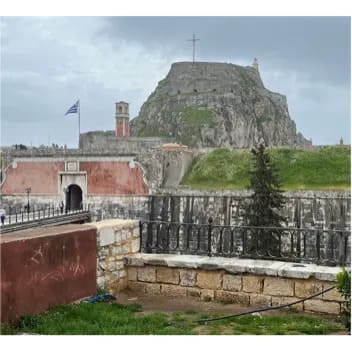
Our next stop was Corfu, Greece. An island with a cosmopolitan Old Town, spectacular sandy beaches, and beautiful landscapes, known as Greece’s “Emerald Isle.” Dominated by the Venetians, French and British over the centuries, Corfu never fell under Ottoman control, like much of Greece. Our tour guide explained the redevelopment of what the people of Corfu call the Esplanade or the Spianada.
The people of Corfu realized that the Ottoman army was coming for them, so they asked the Venetians to protect their seaside town. There was an old fortress on the seaside that could no longer defend the town, so the Venetians built a new fortress and moved the existing homes of the residents, making a large open area, the Spianada or Esplanade.
The Venetians told the Corfunians to rebuild their homes further away from the seaside, with streets between them no wider than 2.5 meters. Venetians also instructed the builders to place the homes to form an arc above the Esplanade. By doing this, invaders would have to break up their armies into smaller groups to traverse the Esplanade and reach the fortress. Once on the Esplanade, the canons of the fortress would rain down death upon them.
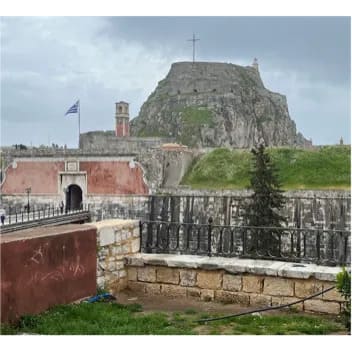
The Venetians built Corfu’s fort on the seaside of the Esplanade, with its cannons pointing inward towards the Esplanade.
We spent a day visiting the small shops above the Esplanade and found beautiful silk pillow covers and other interesting articles to make your trip more memorable.
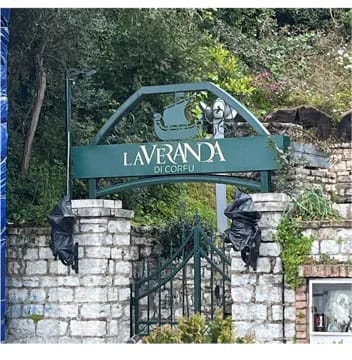
Entrance to the “La Veranda Restaurant “in Corfu offers excellent food and service.
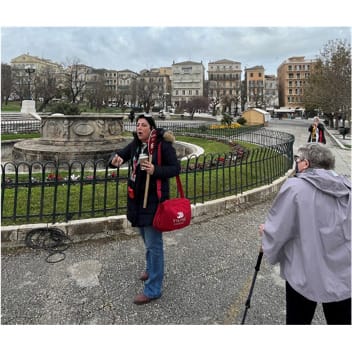
Corfu, Greece, our tour guide, is standing on the Esplanade explaining how the Venetians moved the houses of the Corfunians. Note the houses in the background initially; the houses were one story tall in ancient times.
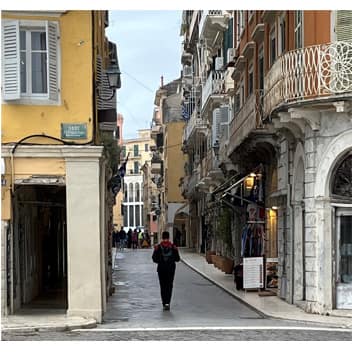
The 2.5-meter spaces between the buildings in Corfu allowed only a few Ottoman soldiers through at a time, where canon balls rained down on them once they reached the Esplanade.
Pompeii and Naples, Italy
That evening, we left Corfu for Naples, the third-largest city in Italy. Napoli, near Pompeii and Herculaneum, the ancient Roman towns were destroyed by the volcano Vesuvius, which is now called Montezuma by the people of Naples. We took a bus to the site where, in 79 CE, a massive super volcano erupted, shooting a cloud of hot volcanic gas, rock, ash, and other debris into the air. Estimates are that the gas and debris traveled over 20 miles into the air before plummeting down on Pompeii and killing some 10,000 or more inhabitants. We saw casts of people still fixed in the same positions during the eruption, many trying to cover their eyes and mouths so they could breathe. Their deaths were instantaneous because the temperature of the debris was well above 400 degrees Fahrenheit.
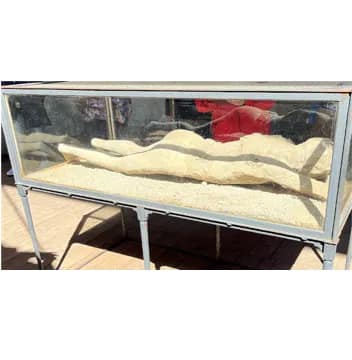
Replica of ash-covered body found after the eruption of Mount Vesuvius in Pompeii
The Pompei of 79 BCE shows the ingenuity of the Roman empire. Stone bridges crisscrossed the pepper stone streets, enabling pedestrians to cross the street without coming into contact with the organic waste, water, and filth that accumulated in the streets.
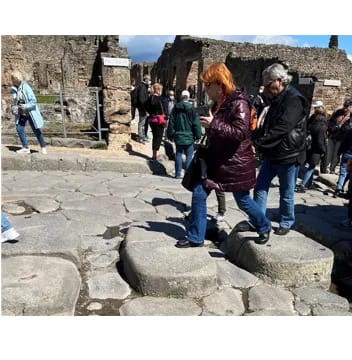
Large stone slabs bridged Pompeii’s streets to cross over organic waste-filled water in the streets
Pompeii even offered “Fast Food” restaurants on its corners, where citizens could buy a fast known as a thermopolium — a snack bar that served drinks and hot, ready-to-eat food.
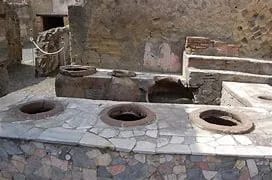
Thermopolium in Pompeii, 79 BCE
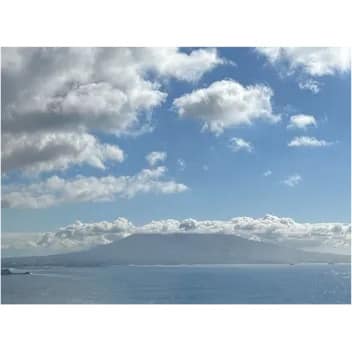
Mount Vesuvius, seen from Naples, with its cloud-covered summit. The eruption of 79 BCE blew the entire top off, causing a pyroclastic flow. Today Naples calls Mount Montezuma.
Like Pompeii, the city of Naples is over a super volcano, which has the potential to erupt anytime. As a result, the area is called The Phlegraean Fields (Italian: Campi Flegrei), or the flaming fields, and experts monitor the volcano continuously. The fields are nine miles west of Naples.
We visited a most impressive expresso shop in Naples, Gambrinus. A must if you are a coffee drinker.
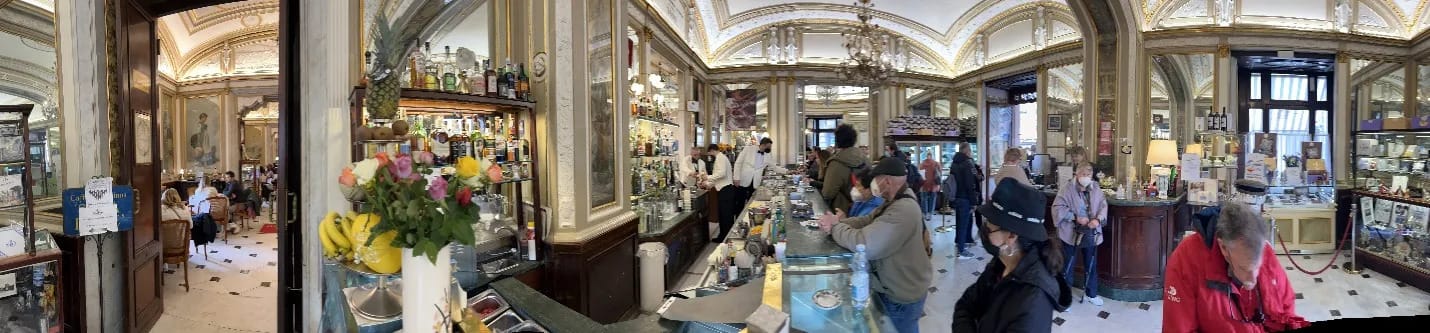
Caffe Gambrinus coffee shop in Naples, Italy, one of the top 10 coffee houses in Europe
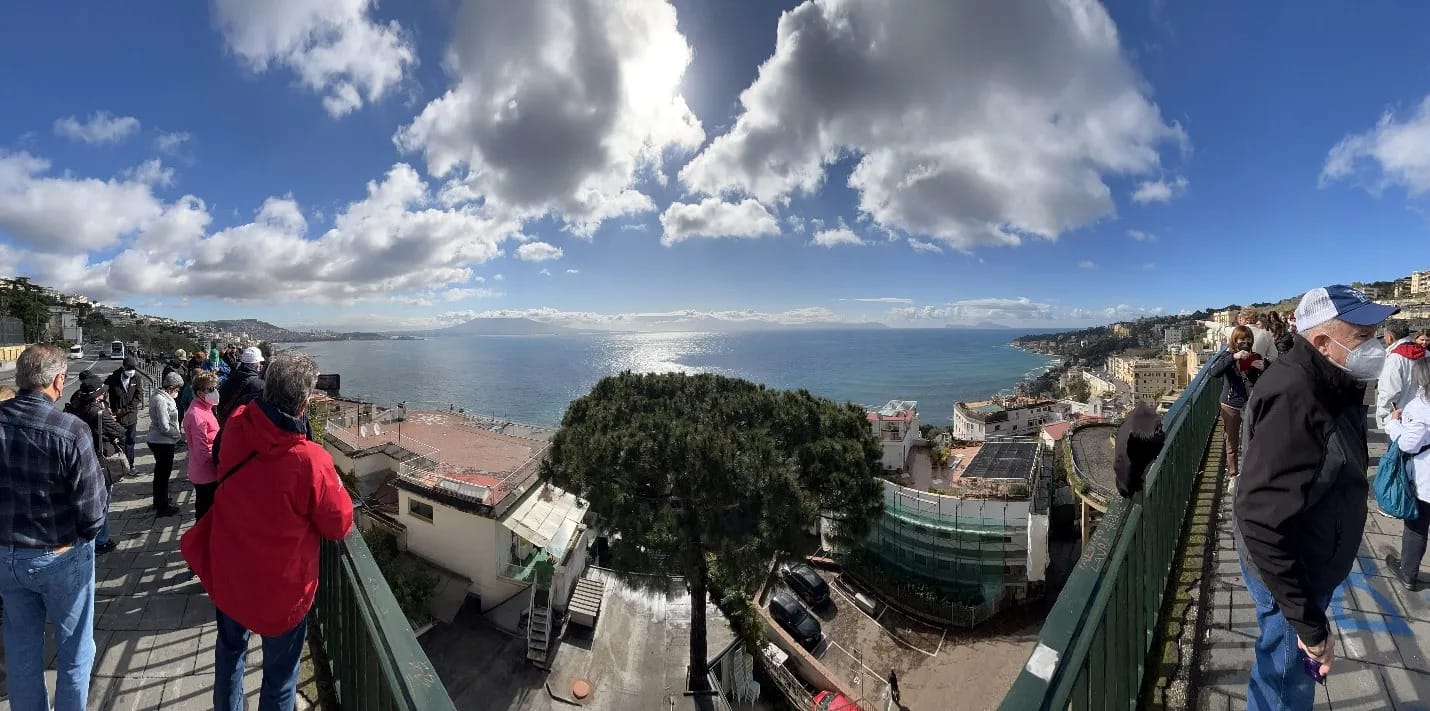
Mount Vesuvius is in the background, surrounded by the “Campi Flegrei.” Nine miles west of Naples.
Wear comfortable shoes for walking on the ancient pepper stone streets of Pompeii, and carry euros as currency, because some stores won’t accept dollars.
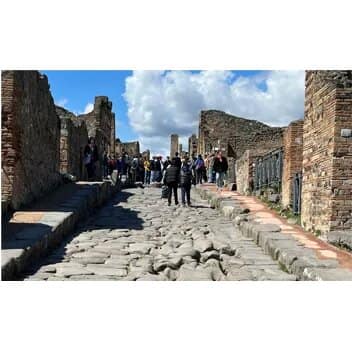
Pepper stone streets of Pompeii
ROME
Up the Mediterranean coast is the largest of Italy’s cities, Rome. Home to the Vatican, a city to itself and not under Italian control. The Vatican is a small country where the Pope, the Catholic church leader, lives. The Romans built an immense empire from this location, and many of their structures still stand 2000 years later. Some parts of Rome still use the aqueducts built almost 3000 years ago. Rome is the oldest continuously occupied city in the world.
There are many wondrous sites in and around this ancient city, and the best way to see those sites is on foot. The Romans built the Colosseum, the Parthenon, the Spanish steps, the Sistine Chapel, and other architectural wonders over 2000 years ago. Yet, they are still standing and visited by millions of travelers yearly.
We boarded our tour bus, and off we went to see the historic sites of Rome. Traffic in Rome is horrendous, and driving in the bustling metropolis is not a good idea. Walking is the safest and easiest mode of transportation. We spent much of our time looking at the traffic jams we seemed to face at every intersection.
The lines to enter the Sistine Chapel with its ceilings painted by the great Michelangelo were long, so if you plan on seeing the chapel, it will take an extended period to gain entry and appreciate its wonder. The tour was a table of contents without the book that should have followed. Comfortable walking shoes are a must, as well as seasonal clothing. We did a little shopping at the Vatican while remaining watchful of our belongings. We were warned by the crew that pickpockets were notorious in the tourist areas, including the Vatican.